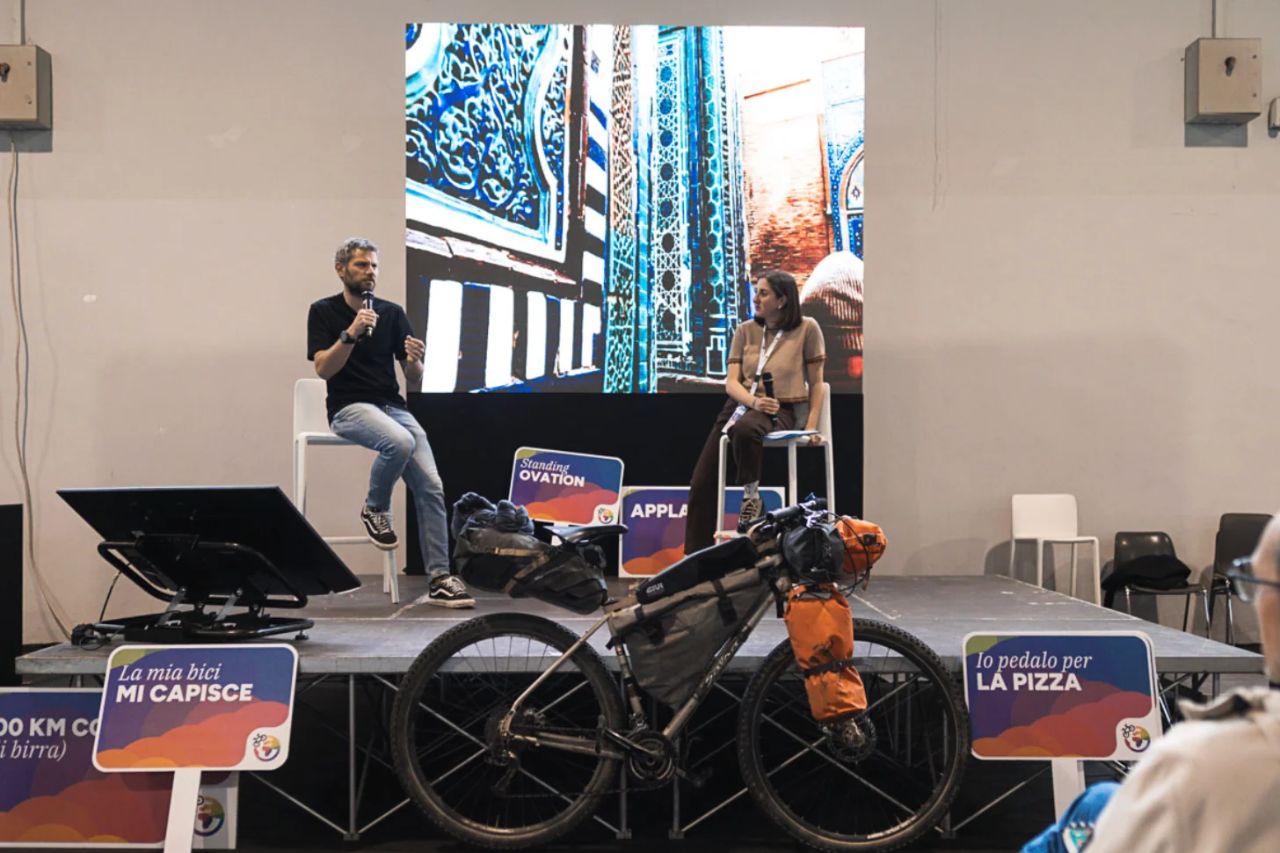

The 5th edition of the report “Traveling by Bike 2025”, by ISNART and Legambiente in collaboration with Bikenomist, was presented on Friday, April 4 at the Cycle Tourism Forum during the Cycle Tourism Show in Bologna.
Italian cycle tourism continues to grow and in 2024 experienced a true boom, with an estimated 89 million visits (+54% compared to 2023) and an economic impact reaching nearly €9.8 billion.

Cycle tourism is confirmed as one of the leading trends
These are the key findings of the “Traveling by Bike 2025” report, now in its fifth edition, produced by Isnart–Unioncamere for the Observatory on the Tourism Economy of the Chambers of Commerce, in collaboration with Legambiente.
Cycle tourism is confirmed as one of the leading trends in the “new demand” for tourism in Italy, accounting for over 10% of all tourists in the country. Roughly half of them are millennials (aged 30 to 44), representing a high-spending segment, with more than half declaring at least a medium-high economic status.
The “Traveling by Bike 2025” report once again highlights the enormous potential of cycle tourism. However, the steady growth in visitor numbers and economic impact seen in recent years appears to be more the result of private entrepreneurial initiative than of a true national policy framework.
We strongly believe that a nationally coordinated policy to promote cycle tourism could lead to even more remarkable outcomes.

Profile of the Cycle Tourist
Demographics:
The average cycle tourist is between 30 and 44 years old (47.7%), followed by 35.4% belonging to Generation X (aged 45–60), who generally have higher spending power than younger travelers. More than 1 in 3 cycle tourists travel as a couple (36.7%), while 31.1% travel solo and 27.5% with friends.
Digital Influence:
63.1% of tourists rely on the internet to plan and organize their cycling holiday. Among them:
- 79.9% base their choice on online information,
- 39.3% are influenced by online deals,
- 34.6% are guided by social media,
- 18.9% consult specialized websites and blogs.
Motivations:
Cycle tourists are drawn by diverse motivations:
- 44.6% cite the richness of cultural and artistic heritage as the main reason for choosing a destination (after sport),
- 33.1% choose for ease of access,
- 30.7% are seeking moments of relaxation.
Spending Profile:
Spending levels have remained stable compared to 2023, both in terms of daily per capita accommodation costs and additional on-site expenses (excluding travel and lodging). However, spending by foreign tourists has increased (132€ in 2024 vs. 104€ in 2023). Preferred accommodations include hotels (53.1%) and B&Bs (19.5%).
Experience Rating:
Cycle tourists give an average rating between 7 and 8 out of 10 for their overall experience.
The most appreciated aspects are: food and drink quality, friendliness and hospitality of the local population (both scoring 8/10). Areas for improvement include: efficiency of local transport (7/10) and availability of integrated cultural offerings for cyclists (7.6/10).

Trend: Women in Cycle Tourism
An analysis of cycle tourism demand along 10 cycling routes and itineraries in Lombardy, Liguria, Friuli-Venezia Giulia, Veneto, Emilia-Romagna, Tuscany, Umbria, Campania, Calabria, and Apulia highlights several areas for improvement, offering valuable policy insights.
These include:
- Significant potential to attract more international tourists through coordinated promotional efforts;
- The need to invest in safety (such as first aid points and expanding food/rest shelters);
- Ongoing quality and maintenance of cycling networks, including better signage, more information points, and expanded bike rental, accessories, and qualified technical assistance services.
Finally, a noteworthy trend is the growing presence of female cyclists, particularly visible on certain routes: Tuscany’s Castles Cycle Route (63% women), Liguria’s Arenzano–Varazze Cycle Route (43%), Calabria’s Parks Cycle Route (41.4%), and Emilia-Romagna (36.3%).