
Organizing a bike trip is always a bit of a challenge. It’s not enough to choose a destination: you need to figure out how far you can ride, where to sleep, which roads are safe, and whether there will be a place to stop for repairs or to refill your water bottles. In the past, all this meant hours of research, forums, maps, and blogs by other cycle tourists. Today, however, there may be a simpler alternative: writing to artificial intelligence.
In recent months, thanks to tools such as ChatGPT or Google’s new AI Mode, artificial intelligence has become an interface that not only responds, but also plans, interprets, and suggests. It’s like having a virtual travel companion who knows the weather, altimetry, cycle paths, and even the availability of accommodation. And if this approach has already changed the way we search for information, it is now set to transform the way we plan our trips.

From idea to practice: how Artificial Intelligence builds an itinerary
When you ask Artificial Intelligence to organize a trip for you, you don’t get a list of links, but a story in the making. Enter your parameters (the number of days, average distance, fitness level, maybe the age of your children) and it starts building a route. It can combine maps, topographical data, and reviews into a single coherent vision, predicting critical points and optimal stops.
It’s a new way of thinking about planning. It’s no longer a matter of “choosing” a route, but of dialoguing with a system that learns from your responses and adapts its proposals in real time. In this sense, Google’s AI Mode anticipates a broader trend: shifting the focus of the web from search to conversation. And in the world of active tourism, this means being able to ask, for example, “I’m traveling with two children aged eight and ten, are there any safe routes with stages of no more than 30 kilometers?” and receiving a plausible itinerary in a matter of seconds, complete with places to stay and points of interest.

The advantages and drawbacks of algorithmic travel
Using artificial intelligence while planning a cycling trip is fascinating, but not without its downsides. The most obvious advantage is personalization: AI can interpret specific needs and transform them into a detailed plan. Then there is efficiency, because it drastically reduces the time needed to compare routes and options, suggesting routes, stops, and travel times quickly and adaptively.
The risk, however, is that of placing too much trust in it. The artificial intelligence systems available today are not designed for cycle tourism: they are generic tools, capable of talking about everything, but not always truly understanding what it means to travel by bike. Sometimes they mix routes for cars, footpaths, or unsuitable dirt roads, creating itineraries that are only apparently coherent. They can misinterpret data, overestimate the safety of a stretch, or not know that a cycle path has been closed for months.
Furthermore, relying completely on an algorithm can reduce the human dimension of travel: chance discoveries, unexpected encounters, the charm of mistakes.

What if there was an Artificial Intelligence designed specifically for cycle tourism?
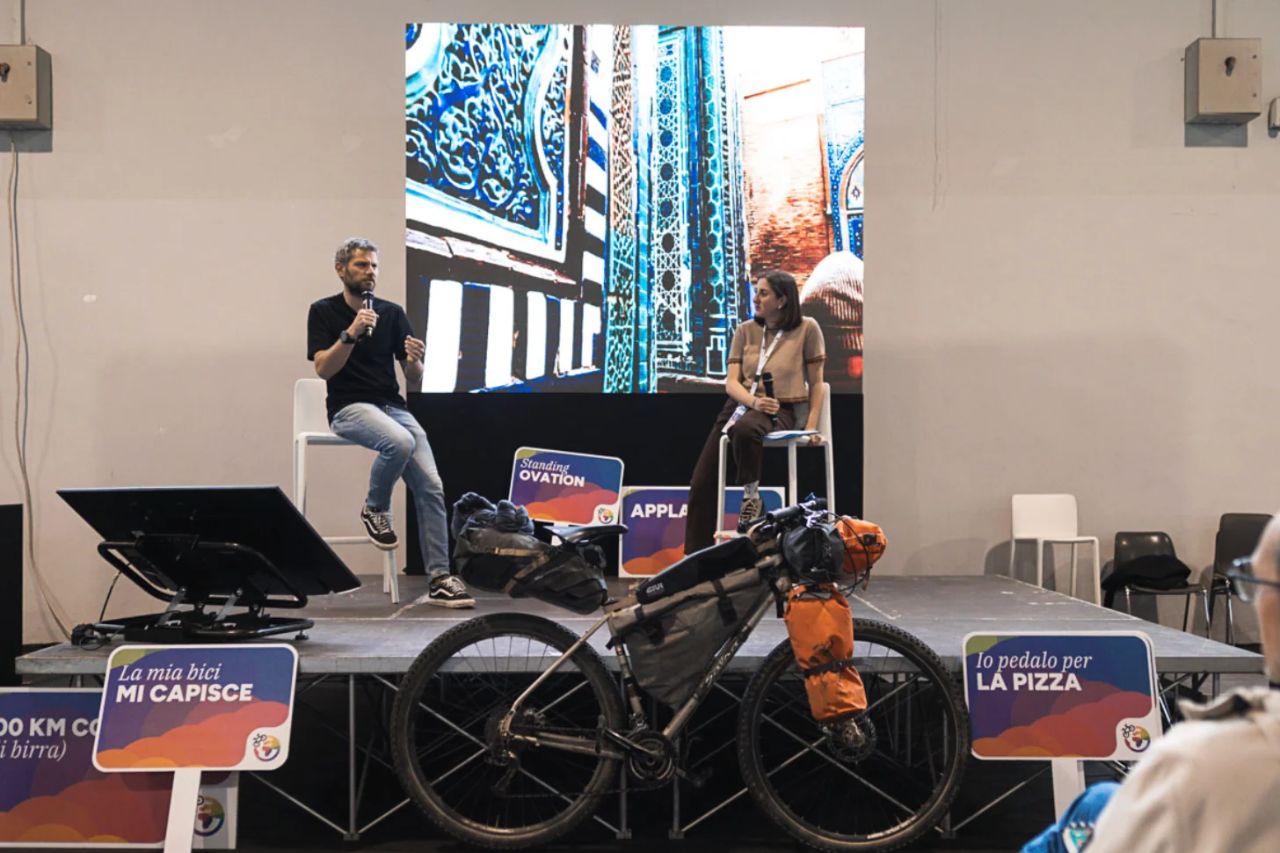
That’s exactly the question we asked ourselves: from there came the idea of developing an artificial intelligence tool dedicated to cycling, which will be presented at the next Cycle Tourism Show. The goal is to create a tool capable of integrating technical data with the real experience of the cycle tourist: routes suitable for different types of bikes, gradients compatible with physical fitness, bike-friendly facilities, rental options, and roadside assistance.
Such a system would not only be a digital assistant, but also a narrative platform for the trip: capable of combining data with emotions, algorithms with storytelling. In other words, a way to rediscover planning not as a limitation, but as a creative act.
Perhaps artificial intelligence will not make traveling easier, but it can make it more conscious. It can help us avoid trivial mistakes, get to know the area better, and set off with a more precise compass. But the meaning of cycling (freedom, rhythm, the wind in your face) will always remain human.
If you want to be part of the change, exhibit at the Cycle Tourism Show.