
Combining train and bicycle to explore Europe is one of the most fascinating experiences a traveler can have. It’s a way to move slowly and connect with the landscape, without giving up the possibility of covering long distances. From the Atlantic coast to the Balkan mountains, every cycle traveler today can rely on a constantly improving rail network for bicycle transport, alongside well-marked and increasingly accessible bike routes such as those of the EuroVelo network. But to take on this kind of journey with peace of mind, it’s essential to understand a few rules, country-specific differences, and helpful strategies.
Taking Your Bike on a Train: What You Need to Know

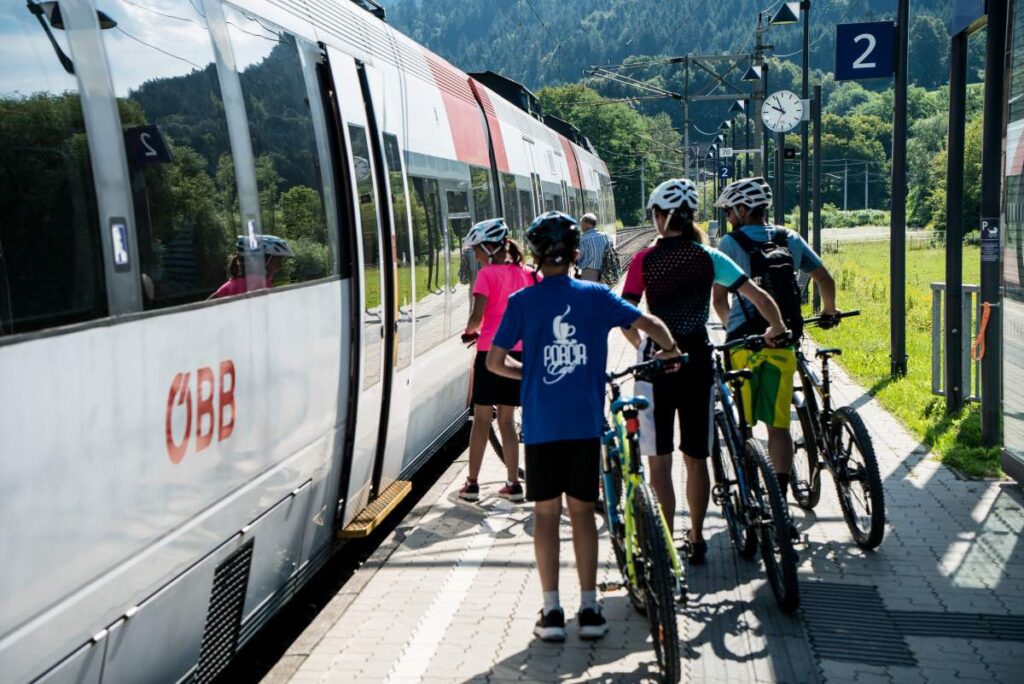
Traveling by train with your own bicycle may seem complicated at first, but it becomes much easier with a few simple guidelines. In general, folding or disassembled bikes are treated like regular luggage and can travel for free on many European trains, as long as they are in a bag or case and meet the size requirements set by the railway company. This is the most flexible option, as it avoids the need to book a bike spot or pay a supplement.
If you want to bring a fully assembled bike, things get a bit more complicated. Regional trains in most European countries accept full-sized bicycles with a small supplement paid when buying the ticket or onboard. However, space is often limited, not reservable, and subject to availability: travelers during peak season or rush hours may have to wait for the next train. On long-distance trains such as Intercity, EuroCity, Railjet, or TGV, bike transport almost always requires advance booking and a specific supplement. Some high-speed trains accept only disassembled bikes, while others offer designated bike spaces—though very limited in number.
In all cases, it’s a good idea to arrive at the station early, especially when traveling with a fully assembled bike. Extra time lets you board calmly and without obstructing other passengers. A few practical tips—like removing panniers or lowering the saddle—make placing your bike in the dedicated spaces easier.
Folding or disassembled bikes
- Often treated as luggage: usually travel free if within size limits (e.g., max 90 × 130 cm)
- No reservation needed, but avoid peak hours (e.g., Netherlands)
Full-sized bikes
- Regional trains: usually accepted with a supplement (e.g., €3–4 in Italy, €7.50 in the Netherlands), no reservation required. Limited space: first come, first served
Combining train and bicycle to explore Europe is one of the most fascinating experiences a traveler can have. It’s a way to move slowly and connect with the landscape, without giving up the possibility of covering long distances. From the Atlantic coast to the Balkan mountains, every cycle traveler today can rely on a constantly improving rail network for bicycle transport, alongside well-marked and increasingly accessible bike routes such as those of the EuroVelo network. But to take on this kind of journey with peace of mind, it’s essential to understand a few rules, country-specific differences, and helpful strategies.

Country Examples (check rail company websites for updates)
France – SNCF
All information available on the SNCF website.
- TGV INOUI or INTERCITÉS: Assembled bike: €10 supplement | Folded or disassembled bike in a cover (max 120×90 cm): free
- TER (Regional Trains): Assembled bikes allowed free in a dedicated bike area without reservation
- OUIGO: Folded or disassembled bike in a cover (max 120×90 cm), by purchasing the “Additional Luggage” option (€5)
Germany – Deutsche Bahn
More details at the Deutsche Bahn site.
- Bikes are allowed on most local, IC, and EC trains, and some ICE trains.
- For long-distance trains, you must purchase a bike ticket and reserve a bike spot in advance.
- Booking in advance is highly recommended; avoid local rush hours.
- On local trains, a daily bike ticket is available via machines, DB centers, or online. No reservation required.
- Note: rules may vary by regional transport authority for local trains.

Belgium – SNCB
All information available on the SNCB website.
- Buy a bike ticket (€4 per one-way trip).
- Folding bikes travel for free.
- Bike supplement is in addition to your personal ticket.
- Speak with the train manager before boarding to check space availability and bike storage.
- Check the travel planner to verify if your train has a bike compartment.
- Avoid rush hours for more convenience.
- Some stations are not bike-accessible: Brussels-Central, Brussels-Congress, and Brussels-Chapel.
Austria – ÖBB
See more on the ÖBB website.
- Bike transport fares vary by time and place of purchase. Tip: buy early to save money. Online/app purchases are cheaper than onboard or at stations.
- Weekly and monthly bike passes are available.
- Use the ÖBB door-to-door luggage service to ship your bike within Austria.
- Folding bikes within 90×60×40 cm travel free as carry-on on all trains, no reservation needed.
- On local, regional, and Railjet ÖBB trains in Austria, larger folding bikes (up to 110×80×40 cm) are allowed for free if placed in marked areas.

How to Prepare: Tips for Cyclists
Planning a train + bike trip across Europe requires some preparation, but it becomes easier with experience. The first tip is to gather accurate information before departure, by checking official railway websites or specialized platforms such as EuroVelo or the national railways of the country you intend to visit. Each country has different rules, especially for long-distance trains, so it’s essential to check if a bike reservation is needed and how much it costs.
Another factor to consider is the type of bike and gear. Owners of folding bikes have greater flexibility since they can access most trains without restrictions or extra fees. Those traveling with a standard bike should consider buying a bike bag to manage routes where assembled bikes aren’t allowed. Often a simple soft case or even a makeshift wrap is enough to meet the requirements.
Finally, flexibility is key. Sometimes the bike coach may be full, or a train may be canceled last minute. In such cases, having a good attitude, some patience, and a backup plan (like an alternative station or riding a stretch by bike) makes all the difference.
In summary:
- Plan ahead: check by route whether a bike ticket or reservation is required (regional trains often show this in Trenitalia/SNCF apps; DB sites show bike options).
- Choose a folding/spare bike or bring a bike bag.
- A compact bag is handy when space is limited or transfers are tight.
- Allow time to board and secure the bike without rushing.
- Consider rail passes like Interrail/Eurail. They simplify travel, but reservations (and bike supplements) are still needed for high-speed or international trains.
- Avoid peak hours (e.g., UK, NL), when bikes may not be allowed or space is limited.
Note: there are often specific rules for e-bikes. Check with the rail operator.

Travel Ideas: Train + Bike with the EuroVelo Network
EuroVelo is a network of international cycling routes spanning over 90,000 kilometers across the European continent, connecting cities, coasts, rivers, and mountains. One of its most appealing features is integration with public transport: many of the routes run near railway stations or regional lines, allowing easy train + bike combinations.
In countries like Austria, Switzerland, and Germany, this integration is already well-developed: many stations along EuroVelo paths offer bike-friendly services, including secure parking, mechanical assistance, and the ability to load bikes directly onto the train.
France and the Netherlands are also improving, with regional routes allowing bikes free or with minimal supplements, and information readily available online or via dedicated apps.
Three EuroVelo Routes to Explore (Also by Train)
Among the many EuroVelo routes, some are particularly well-suited for alternating bike and train segments. A classic example is EuroVelo 6, which follows major rivers like the Loire, Rhine, and Danube across France, Germany, Austria, and on to Romania. Travelers can take advantage of French regional trains along the Loire (where bikes are free) or use Austrian ÖBB trains to tackle mountain sections. In Germany, railways allow easy access with a day ticket for bikes.
Another great option is EuroVelo 15, following the Rhine from its source in Switzerland to its mouth in the Netherlands. This route spans river landscapes and historic cities like Basel, Cologne, and Rotterdam, with good train connections to shorten or skip parts. In Switzerland, SBB trains accept bikes with a reservation, while in Germany and the Netherlands a supplement is often sufficient, provided space is available.
Lastly, those interested in Southeastern Europe can look into EuroVelo 8 or EuroVelo 9, converging toward Slovenia and the capital Ljubljana. These routes combine coastal paths along the Adriatic with Slovenian trains accepting full-sized bikes for a small fee. From Trieste in Italy, rail links make reaching Ljubljana simple—even without a car.
And in Italy?
To learn how to travel by train + bike in Italy, read How to travel by train with your bike in Italy