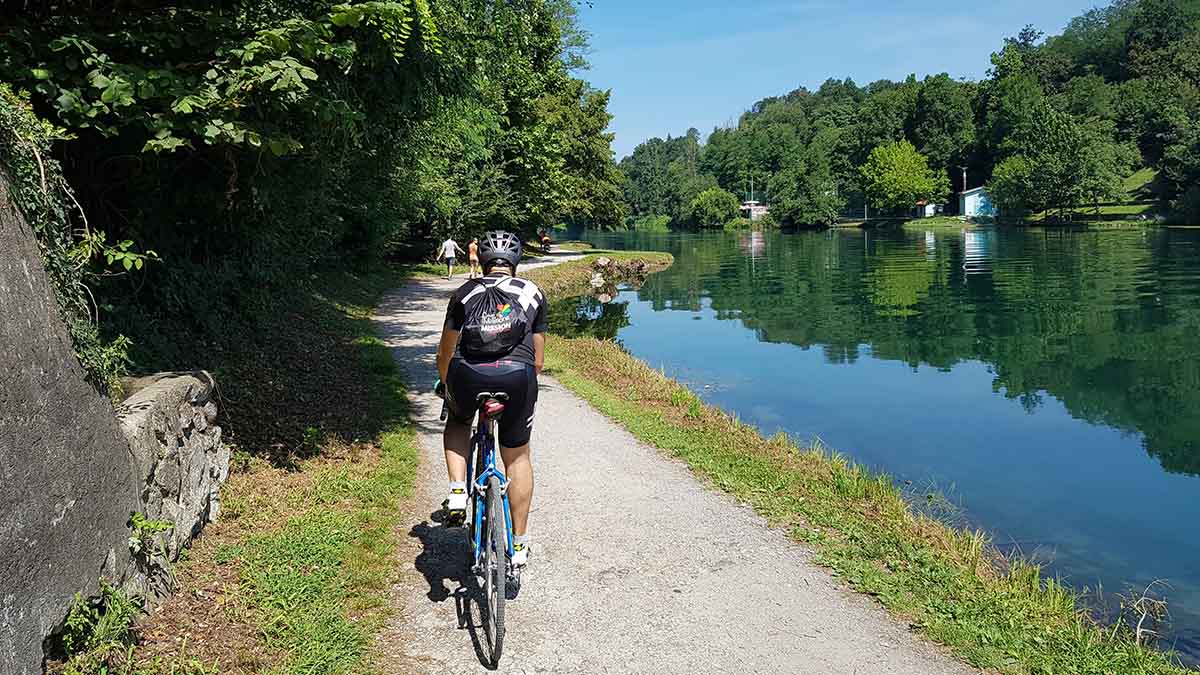

A new international project aims to transform the course of the Sava River into one of the most picturesque cycle routes in Europe: it is called the Sava Cycle Route and in the coming years it will become part of the EuroVelo network under the name EuroVelo 18.
The Sava River originates in the Slovenian Alps, flowing through Slovenia, Croatia, Bosnia and Herzegovina, and Serbia, before joining the Danube in Belgrade. With a length of over 990 kilometers, the Sava crosses very diverse landscapes, from alpine mountains and hills to the plains of Pannonia, skirting historic cities and passing through natural parks and wetlands of great ecological value. The new Sava Cycle Route aims to highlight this landscape and cultural diversity, offering a cycling route that combines nature, history, and local traditions.
This initiative, officially announced by the European Cyclists’ Federation (ECF) at the end of October, represents a fundamental step in the expansion of the European cycle network in the Balkans.

The route and main stages
Sava Cycle Route will cover approximately 1,136 kilometers, crossing Slovenia, Croatia, Bosnia and Herzegovina, and Serbia, connecting three European capitals: Ljubljana, Zagreb, and Belgrade.
The route begins at the Alpine sources of the Sava in Slovenia, among pristine mountains and forests, and crosses the Triglav National Park, one of the most spectacular corners of the country, characterized by snow-capped peaks, rocky gorges, and scenic trails. The route continues to the famous Lake Bled, with its picturesque island and castle overlooking the water, offering cyclists idyllic landscapes and the opportunity to immerse themselves in the local culture.
After reaching the Slovenian capital, Ljubljana, the cycle route enters Croatia, passing through Zagreb and following the course of the Sava River between cities and countryside, until it reaches the Lonjsko Polje Nature Park, a vast wetland famous for its biodiversity and traditional villages, including the picturesque stork village of Čigoć, where you can observe these elegant birds in their natural habitat.

Continuing eastward, the route enters Bosnia and Herzegovina, passing through the town of Brčko and the Bardača wetlands, known for their rich flora and fauna. Here, the cycle route combines stretches surrounded by nature with short passages through small towns, offering an authentic experience of river life.
In Serbia, the Sava Cycle Route passes through places such as Sremska Mitrovica and the nature reserves of Zasavica and Obedska Bara, areas of great environmental value and interest for birdwatchers and nature lovers.
The route culminates in Belgrade, where the Sava joins the Danube and the cycle route integrates with other important routes in the EuroVelo network, such as routes 6, 11, and 13, offering cyclists the opportunity to continue to other European regions along safe and well-marked routes.

EuroVelo’s role
The fact that the Sava Cycle Route has been officially designated as a candidate for the EuroVelo network provides a significant boost to its international visibility.
Furthermore, the candidacy represents a sign of strengthened coordination between the countries it crosses, making the route not only a local infrastructure but a true transnational cycle tourism corridor.
This institutional recognition also brings concrete operational benefits: better integration of infrastructure, greater attractiveness for tourism investment, presence on EuroVelo maps and portals, and potential access to European funding or partners for the development of missing sections. The application therefore acts as a catalyst for raising the standards of the route, contributing to the promotion of cycle tourism even in regions that have had less visibility in Europe until now.

International collaboration in cycle tourism
The Sava Cycle Route is much more than just a cycle path. It is a symbol of international collaboration in the world of cycle tourism, an example of how green infrastructure can become a tool for cooperation and shared growth.
Uniting four countries along a single river also means creating cultural, economic, and environmental ties that transcend borders. In a Europe that is increasingly focused on soft mobility and the enhancement of its territories, the future EuroVelo 18 demonstrates that cycling together can be a concrete way to build bridges between different communities, cultures, and landscapes.