
The 2026 Cycle Tourism Index by Bikenomist and Komoot reveals the top destinations for international cycle tourists. Croatia leads the rankings, while Trentino-Alto Adige stands as the top Italian region, placing seventh overall in Europe. Sardinia and Liguria round out the national podium.
The Cycle Tourism Index 2026, a new report developed by Bikenomist and komoot, was presented on march 28th to a packed room at the Cycle Tourism Show in Padua (Italy), offering what is described as the first comparative, data-based view of how European regions attract international cycle tourists. Based on aggregated cycling activity data from 2025 across 14 European countries, the report introduces both an annual index and four seasonal indexes, designed to show not only where foreign cyclists go, but also when destinations perform best throughout the year.
The report paints a clear picture of cycle tourism in Europe: competitiveness is concentrated above all in Mediterranean and Alpine regions, where tourism appeal, landscape quality, climate conditions and cycling desirability come together in a compelling destination offer. At the top of the overall ranking are Istria in Croatia with 71.12 points, Illes Balears in Spain with 67.35, and Primorje-Gorski Kotar in Croatia with 58.25. They are followed by other high-performing regions including Zadar County, Canarias, Šibenik-Knin, Trentino-Alto Adige, Dubrovnik-Neretva, Lika-Senj and Split-Dalmatia.
One of the report’s clearest messages is that cycle tourism in Europe is no longer an anecdotal or secondary niche. It is now a measurable phenomenon that can be observed comparatively and used to support policy, investment and destination positioning. Rather than attempting to estimate total economic impact, the Cycle Tourism Index is presented as a strategic benchmarking tool to understand international attractiveness, seasonality and regional positioning across European territories.
The report also highlights the rise of a particularly strong Croatian Adriatic system, where success is not limited to a single flagship destination. Instead, multiple regions perform at a high level, suggesting that competitiveness in cycle tourism depends not only on individual excellence but also on a country’s ability to build a legible, continuous and internationally recognizable territorial offer. This is one of the most significant structural signals to emerge from the Index and one with broader relevance for destination management across Europe.
Seasonality is another central finding. The report shows that cycle tourism does not have a single geography across the year, but several seasonal geographies. In winter, the top three regions are Canarias in Spain (67.70), Illes Balears in Spain (64.52) and Istria in Croatia (45.18). In spring, the leading trio becomes Illes Balears (72.98), Istria (69.20) and Primorje-Gorski Kotar (57.28). In summer, the ranking is led by Istria (72.45), followed by Primorje-Gorski Kotar (61.31) and Zadar County (58.50), confirming the strength of the Croatian Adriatic corridor during the peak cycling season. In autumn, the top three are Illes Balears (63.45), Istria (62.13) and Canarias (54.90).
This seasonal reading gives destinations a more precise tool for planning, extending the tourism calendar and distributing flows more effectively across the year. It also reinforces one of the report’s broader conclusions: some regions perform because they dominate a specific season, while others stand out because they remain attractive across multiple parts of the year.
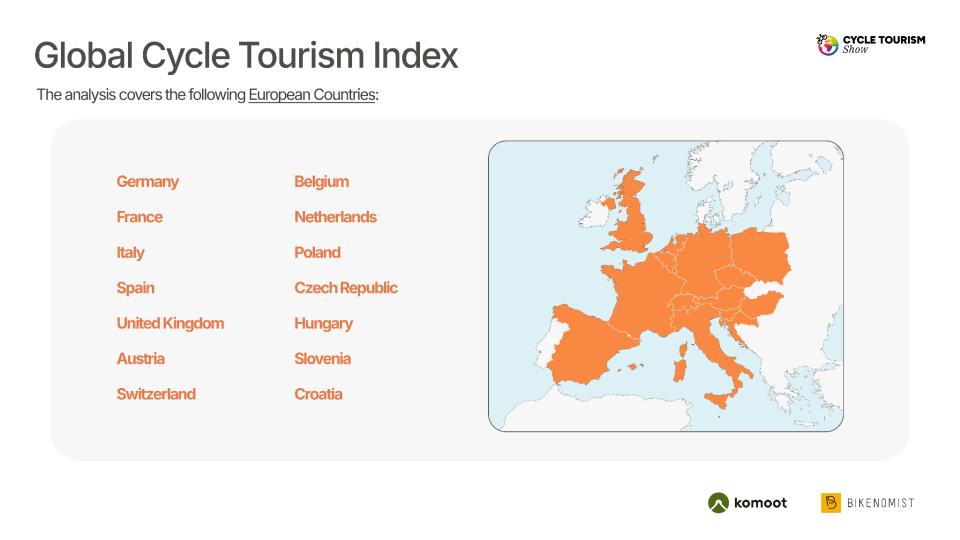
The study covers Germany, France, Italy, Spain, the United Kingdom, Austria, Switzerland, Belgium, the Netherlands, Poland, the Czech Republic, Hungary, Slovenia and Croatia, and is based on aggregated data from foreign users who completed at least one cycling route in the regions analysed during 2025. The report notes that this is not yet a global index, but a first structured step toward a more comparable and strategic understanding of cycle tourism flows in Europe.
Within this broader European landscape, countries and regions can now begin to move from assumptions to evidence when planning growth strategies, investment priorities and positioning in the international cycle tourism market.
“We are very pleased to have launched this collaboration with an important strategic partner such as komoot because, for the first time, the sector will have data it can use as a starting point to plan its growth strategies,” said Paolo Pinzuti, CEO and founder of Bikenomist.
“We are proud to contribute to making cycle tourism more understandable, measurable and strategic for destinations through the Cycle Tourism Index,” says Fiorenza Favero, Sales Manager at komoot. “By leveraging aggregated data from our global community, we can provide concrete insights into international cycling travel patterns and support destinations and stakeholders in unlocking their full potential, creating more attractive and year-round cycling offers.”
For further information, visit cycletourismshow.com
About Bikenomist
Bikenomist is the company behind Fiera del Cicloturismo and has been supporting destinations and companies for the past 15 years in growing within the cycling segment.
About komoot
Komoot is a digital platform for adventurers and outdoor enthusiasts around the world, offering route planning and navigation tools across mobile, web and connected devices, supported by a community of more than 50 million users worldwide.